

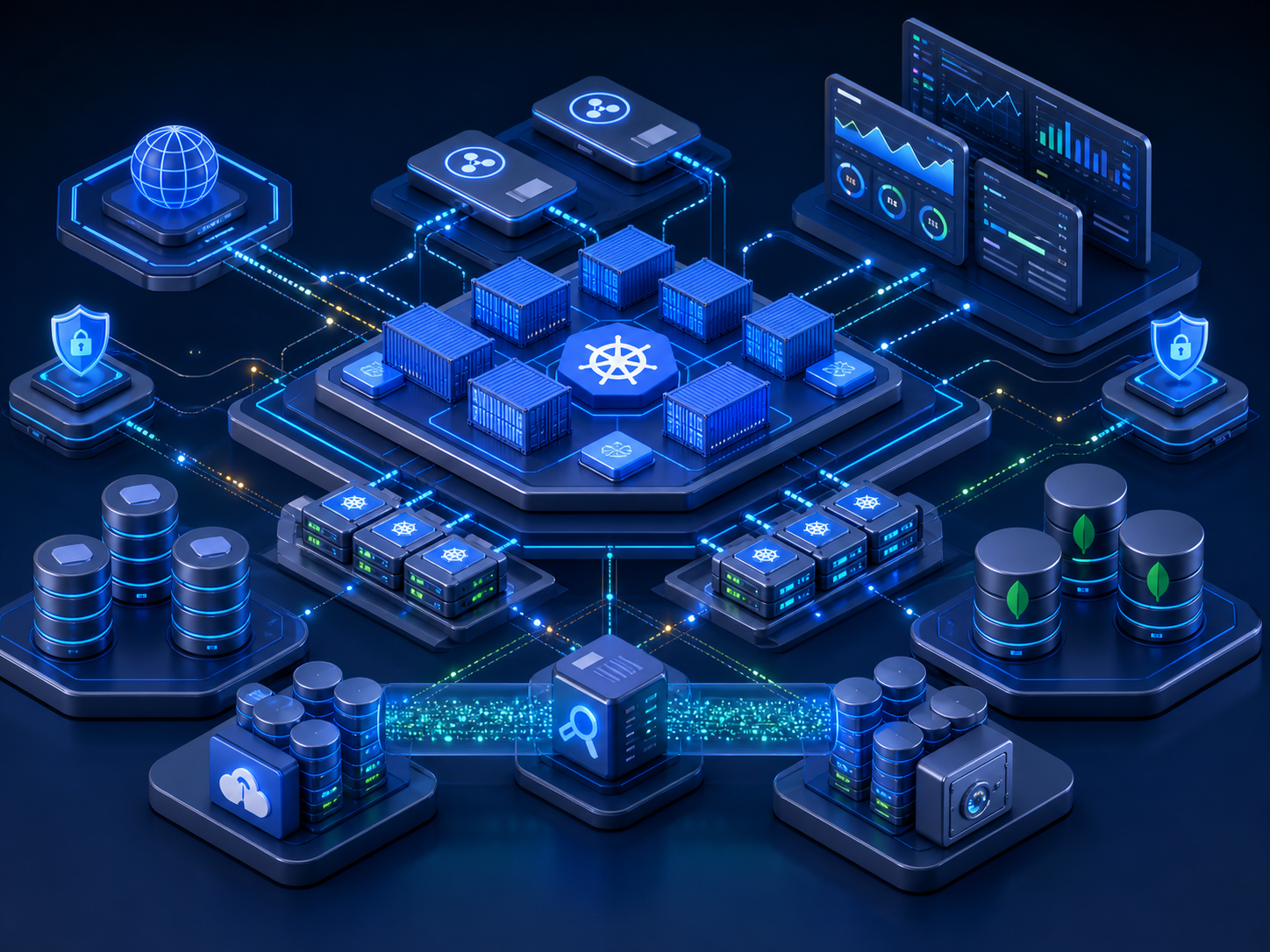
DevOps Infrastructure Consulting & System Design
Architecture consulting for Kubernetes, Docker, MariaDB, MongoDB, ELK, CI/CD, observability, security, backups, migrations, and production operations.
- Estimated Delivery : Up to 4 business days
- Free Shipping & Returns : On all orders over $200
Production-Ready DevOps Architecture for Your Workload
LAPVN provides practical consulting and system-design services for teams building or improving container platforms, Kubernetes environments, database services, and centralized logging infrastructure. We help translate application requirements into an architecture that is operable, secure, observable, recoverable, and appropriate for the available budget and team.
The engagement can cover a new platform, a migration from manually managed servers, an unstable existing cluster, or a focused review of one critical component. Recommendations are based on workload characteristics and operational constraints rather than forcing every customer into the same reference design.
Core technology scope
- Kubernetes: cluster topology, control-plane and worker design, ingress, networking, storage, namespaces, resource management, scheduling, autoscaling, upgrades, and workload deployment patterns.
- Docker and Docker Compose: image strategy, multi-stage builds, runtime hardening, local and small-production orchestration, networks, volumes, health checks, and deployment workflows.
- MariaDB: server topology, replication, high availability, connection management, backup and restore, performance baselines, storage planning, and operational monitoring.
- MongoDB: replica-set and sharding considerations, storage, backup, recovery, access control, capacity planning, monitoring, and maintenance procedures.
- ELK / Elastic Stack: log collection pipelines, Elasticsearch sizing and lifecycle policies, Logstash or alternative ingestion patterns, Kibana access, retention, alerting, and cost control.
What the consulting engagement can include
- Discovery workshop covering applications, traffic, data, compliance, recovery targets, and current operational pain points
- Review of existing servers, containers, manifests, CI/CD pipelines, databases, storage, networking, and monitoring
- Target architecture for development, staging, and production environments
- High-availability and failure-domain planning appropriate to the business requirement
- Security review covering identity, secrets, network exposure, image supply chain, access boundaries, and auditability
- Capacity model for compute, memory, storage, throughput, retention, and expected growth
- Backup and disaster-recovery strategy with explicit recovery-point and recovery-time objectives
- Implementation roadmap with priorities, dependencies, risks, and rollback considerations
Typical deliverables
Deliverables are agreed before work begins and may include:
- Current-state assessment and prioritized findings
- Architecture diagram and component-level design
- Environment and node-sizing recommendations
- Network, ingress, DNS, TLS, firewall, and service-exposure plan
- Storage, database, logging, retention, backup, and restore design
- Deployment standards, configuration examples, and operational runbooks
- Monitoring and alerting recommendations with meaningful service indicators
- Migration sequence, validation checklist, rollback plan, and handover session
Kubernetes architecture and operations
For Kubernetes projects, we evaluate whether Kubernetes is justified for the workload before designing the platform. When it is appropriate, the design can address cluster lifecycle, CNI selection, ingress, certificates, persistent storage, resource requests and limits, probes, pod disruption, autoscaling, policy enforcement, secrets, multi-tenancy, observability, and upgrade procedures.
We can also diagnose recurring operational problems such as failed pod sandboxes, service-routing failures, DNS problems, API-server timeouts, unstable nodes, image-pull failures, storage attachment errors, and poorly sized workloads.
Docker and delivery workflow
Container work can include reviewing Dockerfiles, reducing image size, separating build and runtime dependencies, avoiding privileged execution, defining health checks, handling configuration and secrets, and establishing repeatable Compose or Kubernetes deployments. CI/CD recommendations may include build validation, image scanning, registry flow, environment promotion, deployment gates, verification, and rollback.
Database reliability
MariaDB and MongoDB designs focus on data durability and recoverability as well as performance. The engagement can examine workload behavior, replication requirements, topology, indexes, connection patterns, storage latency, monitoring, backup schedules, restore testing, maintenance, and controlled upgrades. High availability does not replace backups, so both failure handling and independent recovery copies are addressed.
Centralized logging with ELK
An ELK design can cover log sources, field structure, collection agents, parsing, indexing, shard strategy, retention tiers, access control, dashboards, alerting, and storage-cost management. The goal is an operational system that helps answer incidents and application questions without allowing uncontrolled log growth to exhaust the platform.
Engagement process
- Initial consultation: define business goals, scope, constraints, timeline, and key risks.
- Technical discovery: collect relevant architecture, configuration, metrics, failure history, and workload information.
- Assessment: identify gaps, unsafe assumptions, bottlenecks, and operational dependencies.
- Design: prepare the proposed architecture, alternatives, tradeoffs, and implementation sequence.
- Review: walk through the design with stakeholders and incorporate agreed changes.
- Implementation support: provide guidance, configuration examples, validation, or hands-on assistance when included in scope.
- Handover: deliver documentation, runbooks, known limitations, and recommended next steps.
Information needed for a quotation
Send us a short description of the application, current infrastructure, preferred hosting environment, expected users or traffic, data size, availability target, compliance constraints, existing problems, desired delivery date, and whether you need design-only or implementation support. We will confirm scope, schedule, deliverables, assumptions, and pricing before starting.
Important service boundaries
Availability, performance, security, recovery time, and cloud cost depend on implementation quality, workload behavior, third-party services, hardware, hosting providers, and ongoing operations. Recommendations reduce risk but cannot guarantee uninterrupted service or immunity from every failure or attack. Production changes, migrations, destructive tests, and access to sensitive environments require explicit authorization and an agreed change plan.



Reviews
There are no reviews yet.